340B Infusions: Care Continuity and Cost Savings
Why health centers bring high-cost infused therapy on site: care continuity, drug economics, and the staffing, documentation and workflow it really takes.

Remy Healthcare Team
7 min read · October 3, 2024 · Updated August 11, 2026
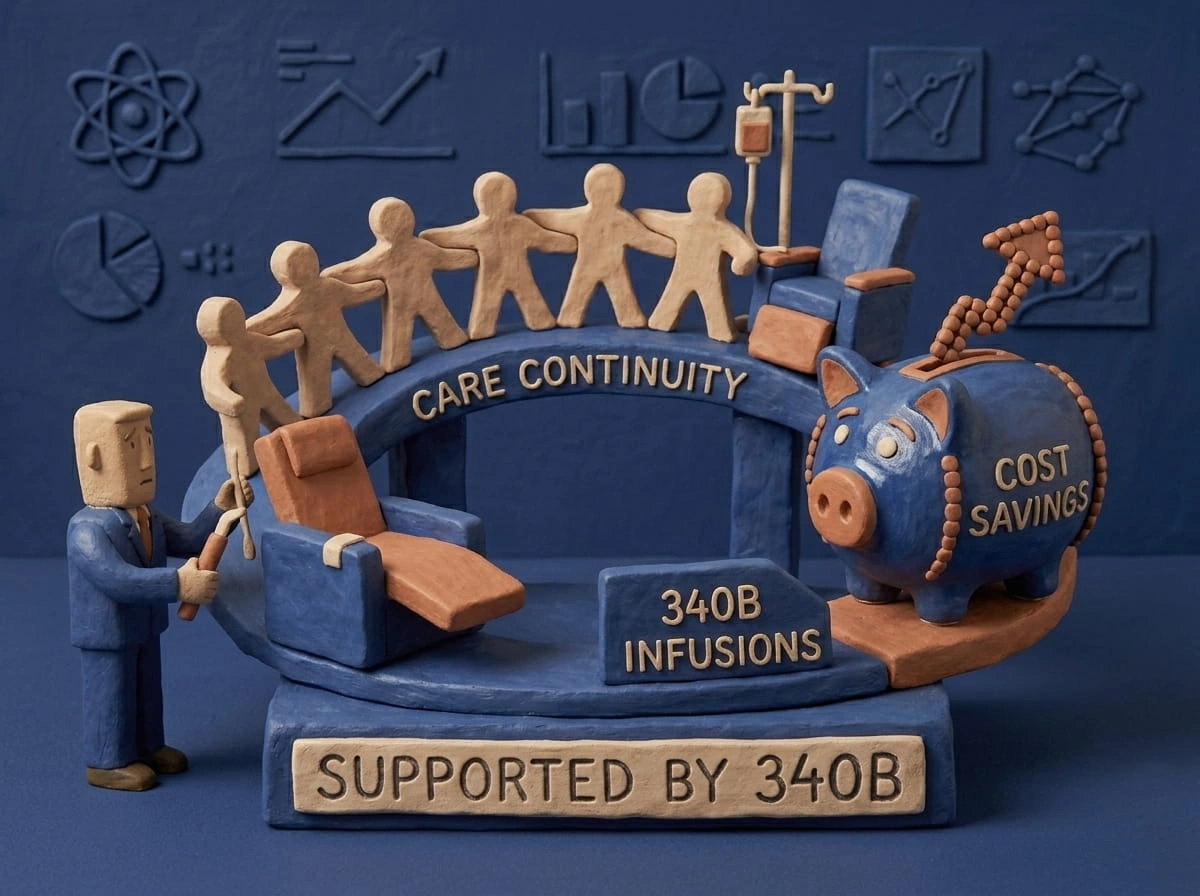
For many FQHCs and safety-net providers, infusion strategy sits at the intersection of patient care and financial sustainability. When high-cost therapies are pushed off-site, organizations often lose more than revenue. They lose continuity, scheduling control, and the ability to keep vulnerable patients inside a coordinated care model.
A well-designed 340B infusion program can change that. It can reduce acquisition cost pressure, help patients access treatment more easily, and create a stronger operating model for high-value therapies.
Key Takeaways
- 340B-supported infusion services can improve both care continuity and drug cost economics.
- In-house infusion reduces treatment friction by keeping therapy closer to the rest of the patient care journey.
- The biggest operational requirements are eligibility discipline, documentation, staffing design, and workflow clarity.
- For many providers, infusion is not only a new service line. It is a stronger way to protect access and retain value.
Why 340B and infusion fit so well together
Infusion therapy is often used for chronic, high-acuity, or specialty conditions that require close coordination over time. These therapies can be clinically essential and financially complex at the same time.
That is where 340B matters. For eligible providers, discounted outpatient drug purchasing can materially improve the economics of infused therapies. Instead of treating drug cost as a fixed barrier, organizations can evaluate whether a compliant in-house model makes treatment more accessible and more sustainable.
What 340B infusion services actually mean
At a practical level, 340B infusion strategy means combining:
- compliant outpatient drug purchasing
- appropriate patient qualification
- safe infusion administration
- disciplined documentation and reporting
When those pieces are aligned, the provider can deliver complex therapies in a more integrated environment instead of handing the patient off to a fragmented external pathway.
The care continuity advantage
Continuity is one of the biggest reasons providers invest in infusion.
When infusion happens off-site, patients often face:
- slower referral flow
- additional travel burden
- more scheduling friction
- weaker communication between prescribers and treatment staff
- lower visibility into whether care stayed on track
When infusion is brought into a closer, more coordinated setting, those barriers can shrink. Patients move through fewer handoffs, care teams see more of the treatment journey, and therapy can feel like part of the health center instead of a disconnected external event.
For organizations serving medically and socially complex populations, reducing treatment friction can be just as important as improving margin.
The cost savings advantage
The other clear driver is drug economics.
Many infused medications are expensive specialty therapies. For covered entities, 340B pricing can improve affordability by lowering acquisition cost and making therapies more financially feasible to deliver in-house.
That does not mean every drug or every infusion scenario works the same way. But it does mean leaders should evaluate infusion services with real 340B economics in mind instead of assuming the service line is automatically too expensive.
Why providers increasingly see infusion as a strategic service line
Organizations typically explore 340B infusion for three related reasons:
- lower drug cost pressure
- better patient access and care continuity
- stronger service-line economics
Those three benefits reinforce each other. When patients can receive therapy closer to home and the provider can acquire medication more efficiently, the care model becomes both clinically and financially stronger, and infusion stays on a single integrated care path rather than branching off into a separate external pathway.
What it takes to set up a 340B infusion clinic
The strongest launches start with a disciplined setup process, which is what our ambulatory infusion center setup engagements are built around.
1. Confirm eligibility and program fit
Before launch, the organization needs to confirm that the infusion opportunity fits both 340B program rules and the actual patient population it serves. That includes therapy mix, referral patterns, and operational feasibility.
2. Design for compliance from day one
Infusion programs can create audit risk if documentation and patient qualification are weak. Covered entities should build clear policies for:
- patient eligibility
- drug purchasing logic
- documentation trails
- reconciliation and internal review
3. Validate the physical setup
Many providers can begin with a compact clinical footprint, but the space still needs to support safe medication handling, patient comfort, observation, and emergency readiness. We have seen programs start in rooms of roughly 250 square feet, though that is an observation rather than a standard. The space you actually need is driven by state licensure requirements, planned chair count, and medication-handling needs, so confirm those before committing to a footprint.
4. Build the staffing model
An infusion service line requires more than chairs and pumps. It needs dependable nursing, pharmacy coordination, scheduling, billing awareness, and escalation pathways.
5. Put the right systems in place
Inventory, patient qualification, documentation, and billing workflows all benefit from integrated technology. The goal is not more software for its own sake. The goal is fewer blind spots and fewer manual errors.
Running infusion well matters as much as opening it
A successful launch is only step one. The long-term value comes from operating the clinic with consistency.
Strong ongoing management usually includes:
- internal compliance reviews
- documentation that can withstand audit review
- regular reconciliation of drug and patient data
- visibility into reimbursement performance
- workflow review as volume grows
Where TPAs fit into the model
For some providers, a third-party administrator can help reduce operational burden, which is the role our 340B TPA services play. That can be especially useful when the organization wants to strengthen:
- inventory oversight
- patient eligibility workflows
- compliance reporting
- administrative coordination
But the provider still needs ownership. A TPA can support the model; it should not replace internal clarity about how the model works.
Why this matters for the patient experience
The patient impact is easy to miss if you only look at revenue.
When care stays closer to the health center, patients often gain:
- easier access to treatment
- fewer off-site referrals
- less travel stress
- more connected communication
- better adherence to ongoing therapy plans
For chronic-condition patients who need reliable treatment over time, that continuity can materially shape outcomes.
340B infusion is not just a financial decision
It is a strategic care decision with financial consequences.
Organizations that evaluate infusion only through drug cost may underinvest. Organizations that evaluate it only through growth projections may overreach. The strongest programs balance access, compliance, workflow, and economics together.
That is where 340B-supported infusion becomes most valuable.
Frequently Asked Questions
- Why are providers interested in 340B infusion services?
- Providers are typically motivated by a combination of lower drug acquisition cost, stronger care continuity, and the ability to keep more high-value therapy inside a coordinated care model.
- Do patients need to meet specific eligibility requirements for 340B infusion?
- Yes. Covered entities need clear, defensible patient qualification and documentation processes to ensure infused therapies are administered under a compliant 340B model. HRSA guidance describes a three-part test: the covered entity has established a relationship with the individual such that it maintains records of that individual's care; the care was provided by a provider employed by the entity or working under a contractual or other arrangement with it, such that responsibility for the care remains with the entity; and the service is consistent with the entity's federal scope of project. This patient definition comes from HRSA program guidance rather than codified regulation, so covered entities should confirm the current guidance and apply it conservatively.
- Does opening an infusion clinic require a large buildout?
- Not always. Many providers can begin with a compact clinical footprint if the space supports compliant workflows, patient comfort, observation, and safe medication handling.
- What is the biggest operational risk in a 340B infusion program?
- A common risk is weak compliance design, especially around patient qualification, documentation, and reconciliation. Those elements should be built into the model before launch.
Evaluating 340B infusion for your health center?
We help providers assess infusion opportunity, space, compliance, workflow, and economics so the program supports both access and long-term sustainability.
Request a discovery callWritten by
Remy Healthcare Team
340B & FQHC Specialists
The Remy team advises FQHCs and 340B covered entities on program management, infusion operations, and revenue optimization.